
Residential Door Hardware Upgrades
Greater Houston Area Home Security Improvements
Professional. Trustworthy. Authoritative.
Protecting a home starts at the door. Guardian Safe & Lock installs, upgrades, repairs, and certifies residential door hardware across the Greater Houston area.
We focus on simple, high-impact interventions — upgraded deadbolts and handlesets, reinforced strike plates and boxes, secure secondary locking points, and proven hardware choices — that measurably reduce the risk of forced entry while preserving convenience for residents.
Call us at: 832-534-8687. Or, text us (including photographs) at 832-493-5888.
Core Upgrades We Recommend & Install

-
ANSI/BHMA Grade-2 or Grade-1 exterior deadbolts
We select a Grade-2 or Grade-1 high-security deadbolt for any principal exterior entry. Grade-1 and Grade-2 hardware meet the most rigorous mechanical and endurance tests and significantly raise the baseline resistance against forced entry.
-
Reinforced strike plates and long screws
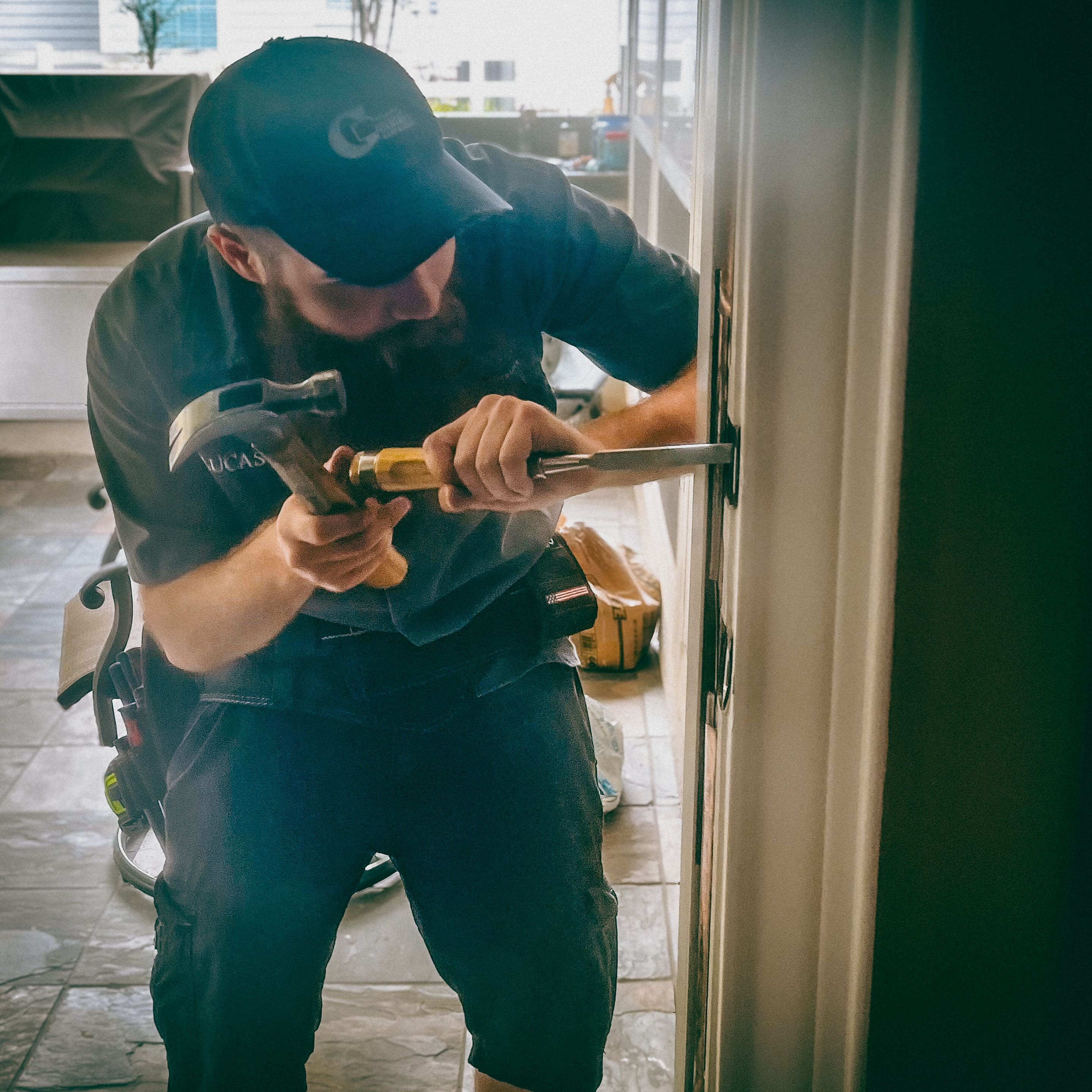
Our technicians replace factory strike plates and short screws with reinforced plates and hardened screws that penetrate the door framing/stud (typically 3″ or longer). This simple hardware swap changes the failure mode of a forced kick from the frame to the structure behind it.
-
High-quality deadbolt cylinders and anti-drill features
We select cylinders with hardened steel inserts and pick/drill resistance appropriate for your neighborhood risk profile. Manufacturers publish BHMA/BMA ratings for these features.
-
Auxiliary locking points and handlesets
Installing a secondary deadbolt or multi-point lock paired with a robust handleset increases mechanical complexity and slows or deters opportunistic attackers.
-
Door edge reinforcement & wrap plates (select installations)
For doors that remain otherwise well-fitted, targeted edge or jamb reinforcement can be installed to distribute load and reduce the chance of splitting under impact. Reinforcement products and tested strike systems are used where appropriate.
These upgrades are designed to be complementary — a Grade-1 deadbolt without proper strike reinforcement remains a weak link. Conversely, reinforcement with a poor cylinder still leaves vulnerabilities.
How Forced Entry Normally Succeeds — & How Upgrades Stop It
Statistically, a majority of residential burglaries involve forcible entry, and most burglaries occur on the first floor. Attackers commonly exploit the path of least resistance: weak strike plates, short screws, hollow door edges, and inexpensive locks with poor mechanical resistance.
For example, national data show that forcible entry is present in a large share of burglaries and that residential properties account for a majority of burglary offenses.
The Typical Door Hardware Failure Sequence:
-
The attacker applies blunt force or a quick, concentrated kick to the area of the door immediately surrounding the lockset.
-
The factory-installed strike plate and short mounting screws fail under load, allowing the strike to tear free from the door frame or causing the surrounding wood to crack and split.
-
Once the strike plate or adjacent frame material fails, the locking mechanism is rendered functionally irrelevant, regardless of the deadbolt’s quality or security rating.


How Our Recommended Upgrades Change That Outcome:
-
Long, hardened screws anchor the strike plate into the structural stud behind the jamb, preventing the strike from ripping out with a single forceful impact.
-
Reinforced strike systems and wrap plates increase the surface area and number of fasteners holding the assembly, dramatically increasing the force required to separate door from frame.
-
Grade-1 deadbolts and hardened cylinders are tested to resist torque, impact, and drilling, increasing the time and tools an attacker must invest.
These measures do not make a door invulnerable, but they convert a low-effort opportunistic attack into one that is noisy, time-consuming, and more likely to be interrupted — which is precisely the deterrent effect homeowners want.
Practical, Tested Installation Details We Follow
-
Screw specification: replace factory screws with hardened steel screws of at least 3 inches for the strike plate and the deadbolt’s faceplate. Where site conditions permit, screws of 3.5″ provide additional purchase into the structural stud. Use #9 or #10 diameter hardened fasteners with self-tapping points where needed.
-
Strike plate placement: where possible, install a reinforced strike assembly that distributes load across the jamb and into the stud; in high-risk openings, we use tested strike systems rather than the small flat plates supplied with many locks.
-
Cylinder choice: install deadbolt cylinders rated for pick and drill resistance, matching the hardware grade and conforming to recognized manufacturer testing.
-
Testing: after installation, we mechanically test locks and reinforcement under controlled force to verify integrity and document the result for the homeowner.
We avoid unnecessary disruption: most single-door reinforcement installs are completed in one site visit, with minimal trim work and no structural rebuilding when performed correctly.


Homeowner Upgrade Priorities
-
Replace the deadbolt with a Grade-1 deadbolt and hardened cylinder.
-
Install a reinforced strike plate and replace all strike screws with 3″ hardened screws.
-
Add a secondary mechanical locking point or tested wrap/edge reinforcement if the door design allows.
-
Document and label keys; consider a keyed control policy if multiple occupants or tenants are involved.
Implementing steps 1 and 2 together yields the largest single-visit reduction in forced-entry vulnerability.
Our Residential Service Area
Based in Tomball, we serve the Greater Houston area, including (but not limited to) the surrounding suburbs:
Tomball • Bryan • College Station • Conroe • Cypress • Humble • Katy • Kingwood • Magnolia • Pasadena • Porter • Spring • Sugar Land • The Woodlands • & more!
If you are outside these areas, we may still be able to service you: Call 832-534-8687 to confirm availability.
Cases Where Additional Measures Are Appropriate
-
Multi-unit dwellings — coordinate with property management; tenant-level upgrades may require permission and standardized hardware to maintain consistency.
-
Historic or specialty doors — where trim or material is sensitive, we select minimally invasive reinforcement systems that preserve aesthetics while improving resistance.
-
Supplemental recommendations — while this page focuses on mechanical door hardware, layered measures (lighting, security cameras, neighborhood awareness, alarm systems) further reduce risk and are recommended as complementary protections.


Why This Approach Matters
Industry standards (ANSI/BHMA grading) and field testing consistently show that hardware grade and proper anchoring into the structural framing are decisive factors in mechanical door strength.
Reinforcement products that transfer load to the stud, combined with high-grade cylinders, materially increase the effort and time required for an attacker to gain entry, which is the practical outcome homeowners need.
Which single upgrade gives the biggest reduction in forced-entry risk?
If you have to pick one change, replace a low-grade deadbolt with a BHMA/ANSI Grade-1 deadbolt and fit a reinforced strike plate secured with long, hardened screws that reach the structural framing.
Upgrading both the cylinder and the strike together converts an easy, noisy kick-in into a slow, difficult attack—this combination produces the largest single-visit improvement in real-world resistance.
Do longer screws really make that much difference?
Yes.
Factory strike screws (often short machine screws) leave the strike anchored only to the trim or soft jamb. Replacing them with hardened screws of approximately 3 inches or longer anchors the strike into the stud behind the jamb.
That change shifts load to structural framing and is one of the most cost-effective, demonstrable improvements against kick-in attacks.
Can you strengthen my existing door without replacing the door itself?
Yes.
Many effective reinforcement measures—upgrading the deadbolt cylinder, installing a Grade-1 deadbolt, replacing the strike with a reinforced system, and using 3" hardened strike screws—can be installed with minimal alteration to the door face and trim.
In most cases, the door stays in place and work is completed in a single visit. We assess each door for specific constraints (material, panel design, thresholds) before recommending the least invasive solution.
Will reinforcement make the door look bad or harm the entry aesthetics?
Not necessarily.
Many modern reinforcement kits and higher-grade hardware are available in finished designs to match door hardware and trim.
For sensitive or historic doors, we recommend minimally invasive reinforcement options that preserve visual character while materially improving strength.
We always review the finish and sightline impact in our written proposal.
How do burglars usually gain entry, and how do upgrades change that behavior?
A large portion of residential burglaries involve forcible entry; historically, over half of burglaries analysed involved forced entry, and most burglaries occur at residences.
Attackers favor quick, low-effort techniques that exploit weak strikes and short fasteners.
Upgraded deadbolts, hardened cylinders, reinforced strike systems, and long screws increase the time and effort required for entry, turning opportunistic attempts into noisy, time-consuming efforts that are more likely to be interrupted.
Do these mechanical upgrades help against all types of break-ins?
Mechanical upgrades greatly improve resistance to forced physical attacks (kick-ins, pry attacks at the strike).
They do not address non-physical vectors such as social engineering, methods that bypass hardware (e.g., unsecured second-floor entry), or vulnerabilities in electronic systems.
For layered protection, combine strong mechanical hardware with visibility, lighting, and controlled access where appropriate.
Our Other Locksmith Services
Looking for more security options? You can also call, text, or email us about other options, including:
- Access control system installation (Including automatic door openers, card access systems & mobile credentials, commercial buzz-in systems, commercial keypad locks, electronic door hardware, electric strikes, and magnetic locks (maglocks)
- Intercom Systems (Audio & Video)
- Surveillance Cameras (Including Eagle Eye Networks, Alibi, and Hikvision systems)
- Emergency locksmith services
- Automotive locksmith services (Including key programming)
- Safes & Gun Safes in Houston (including sales & services)
Request An Assessment Or Schedule Installation
If you want a professional assessment for a specific door or need retrofitted reinforcement across multiple entries, contact Guardian Safe & Lock with your address and photos of the existing hardware:
-
Call: 832-534-8687 (click to call on mobile)
- Text: 832-493-5888 (Tap to text, including images)
On request, we provide a written scope, parts list (including Grade-2 deadbolts, reinforced strike plates, and recommended screw lengths, etc., as necessary to secure your home), and a firm price before work begins. Service windows and parts availability vary by neighborhood; typical single-door installs in Houston are completed the same day or within 48 hours.
If you’d like, we can prepare a short checklist or estimate tailored to your property (upload photos or describe the door and current hardware) and include a prioritized plan with parts and labor.